

KITS WITH SAAF DECALS INCLUDED
72nd scale
Airfix Spitfire MkVC (kit number 02040)
Markings for for a 2 squadron SAAF Spitfire DB-R included
Airfix Spitfire MkVC (kit number A2108)
Markings for for a 2 squadron SAAF Spitfire DB-V included
48th Scale
Hasegawa 48th scale Sitfire MkVB "Ian Glead"
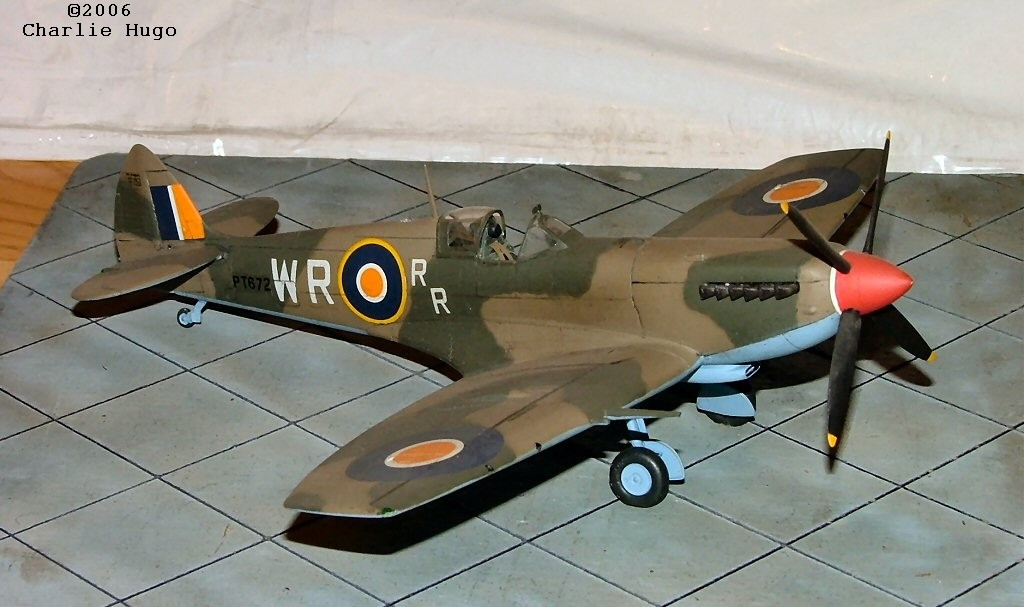
Markings for a 40 squadron SAAF Spitfire WR-R included.
Airfix 48th scale Spitfire MkVC
Markings for for a 2 squadron SAAF Spitfire DB-R included.
Eduard Spitfire MkVC
Markings for for a 2 squadron SAAF Spitfire included
Eduard Spitfire MkVIII (weekend edition)
Markings for for a 2 squadron SAAF Spitfire included
Eduard Spitfire MkVIII
Markings for for a 1 squadron SAAF Spitfire AX included
Eduard Spitfire MkIX
Markings for for a squadron SAAF Spitfire CA-G included
THE MODELS
1/72nd Scale Tamiya Spitfire MkVB
 |
 |
My 48th scale models have covered some of the other major SAAF Spitfire users and I was not ready to tackle another Spitfire MkVC (or any other Mk?C conversion) I looked around for alternatives. On page of The Spitfire in SAAF Service is a clear side on photograph of a line up of 1 Squadrons Spitfire MkVB's and the desert colour scheme, resplendent with 1 Squadrons red wing tip markings appealed to me. Thus, I decided to use the Tamiya MkVB kit for this quick build. I did no corrections to the kit at all other than adding basic seatbelts from tape.
1 Squadron for a time period operated their aircraft without the main canopy so after I had painted and decaled the model I removed the center section by carefully cutting with a razor saw.
These MkVB Spitfires did not have the later wide chord Rotol propeller with the more well-known large spinner fitted so into the spares box I dove. I looked at various Spitfire propeller options that I had to hand and chose the one from the Airfix MkI kit. I found that there was discrepancy in the diameter of the Airfix propeller and the Tamiya cowling with the Airfix part being decidedly smaller than the Tamiya section.
The markings came from the Ken Smy's SAAF markings no 4 sheet with code letters and serial number from various Superscale and Modeldecal sheets
1/48th Scale Hasegawa Spitfire MkVB
 |
 |
This model was built straight out the box using the Hasegawa Spitfire MkVB kit, kit number. This release included the markings for a 40 squadron SAAF aircraft. The only issue one needs to be aware of is the 40 squadron SAAF were a low level photoreconnaissance unit and were thus fitted with the oblique camera in the fuselage where the radio set was normally fitted. I reproduced this by using a spare camera panel from the Airfix Spitfire Mk24. The model was finished off in standard RAF desert colours and the kit decals were applied.
1/48th Scale Spitfire MkVC (Tamiya kit converted)
 |
 |
Having completed the Spitfire MkIX conversion I had a couple unused C-wing panel covers left over. For many years I had been enamoured by a series of SAAF Spitfire profiles done by Ron Belling in an old Wings over Africa publication in which he depicted a MkVC in an unusual overall Light Mediterranean Blue scheme I decided to build this myself. Following the same procedure as I did when building the MkIXE except for the carving for the second radiator I converted another Tamiya Spitfire MkVB to a MkVC. I made up new canon barrels from brass rod that I chucked into my motor tool and using sandpaper and needle files turned them to shape. One could purchase brass canon replacements.
Some years later in Steve Mclean's book I find that this aircraft was in a two-tone colour scheme consisting of MSG upper surfaces with PRU Blue on the underside. Maybe one day I will strip and repaint my model.
1/48th Scale Spitfire MkIX (Tamiya kit converted)
 |
 |
In the early '80's a reborn Spitfire MkIX graced the South African airshow scene. She was most popularly known as "Evelyn", named after the owners wife. Sadly, she was sold and left our shores to the chagrin of many South African airshow enthusiasts. This aircraft now resides in a museum in Brazil, unfortunately no longer in her South African colours.
The colour scheme was based on that of a Spitfire flown during WWII by a pilot who was destined to become Chief of the South African Air Force, a certain Bob Rogers. 40 Squadron was performing low level Tac-R missions which accounts for this colour scheme.
This, one of my early forays into building SAAF Spitfires and conversions was very quickly accomplished by using the Hi-Tech Spitfire MkIX conversion set and a Tamiya Spitfire MkVB. As 40 squadron was conducting low level photo-reconnaissance missions their Spitfires were painted in Dark Earth and Dark green on the upper surfaces with Azure Blue on the undersides. Very unusual indeed.
The national markings on my Spitfire came from the ubiquitous Ken Smy sheet no4 and the code letters and serial number from various Microscale and Modeldecal sheets. The 40 Squadron badge came from a limited run sheet made by Whirlybird productions in the UK.
Of course with the release of the Eduard kits this conversion is obnsolete, but never-the-less, at the time I thoroughly enjoyed the build.
href="/index.php/scale-modelling/saaf-in-scale/spitfires?bod=wildaviation/modelling/Spitfire/48thSpitfireMkIX" title="">In-depth conversion article
1/48th Scale Spitfire MkIXE low back(ICM Spitfire MkXVI)
 |
 |
At the end of WWII the SAAF choose the Spitfire MkIX's as their standard fighter. 80 Spitfire MkIX's were gifted to the SAAF and a further 59 were bought from RAF surplus stocks and brought into post WWII SAAF service. Although they were all MkIX's they were of different production standards and both the high back and low back versions (most seen on the MkXVI) and both clipped wings and standard wings were used. The SAAF Spitfires were capable of having the 60-pound rockets and/or bombs under the wings. I choose to build a low back Spitfire for my late SAAF Spitfire. This model was built straight out the box using the ICM Spitfire MkXVI. My model was built clean without any underwing armament.
I built the kit as ICM intended and painted it the last scheme that the SAAF used on their Spitfires. This was Extra Dark Sea Grey upper surfaces with Medium Sea Grey under surfaces. The decals were sourced from a Carpena sheet covering exotic Spitfires. No underwing serials are included though so these will need sourcing from an alterntive .


